
There is a particular quality of attention that belongs to the very early part of the day, before most of what the day will ask has arrived. A morning yoga sequence, when it has been practised long enough to require no deliberation, is one of the few ways to inhabit that quality with some degree of intentionality. What follows are observations on what makes a morning flow sustain itself over time — not as instruction, but as a set of notes from a practice that has been running for some years.
The Architecture of Repetition
A morning routine earns the word "routine" only once it has ceased to require active decision-making. Before that threshold is crossed, what exists is not a routine but a series of intentions — intentions that compete with all the other things a morning presents. The question of how to build a yoga sequence that holds its shape across weeks and months is, at its centre, a question about what removes the friction of choice.
The sequences that persist tend to share certain structural qualities. They begin in the same posture each session — often supine, often with an attention-settling breath count. They move through a familiar order: spinal mobilisation before weight-bearing, joint-opening before balance work. They end in the same way they began, with a brief stillness that signals completion. These are not aesthetic choices. They are the load-bearing elements of the architecture.
What makes repetition in yoga different from repetition in many other morning habits is the degree to which attention is engaged throughout. Running, for instance, can be done in a dissociative state. Yoga, particularly when postures are held and transitions are deliberate, maintains a thread of attention that running does not require. This is not a claim about superiority; it is an observation about the quality of morning time that each practice produces.
“The sequences that persist tend to share certain structural qualities. They begin in the same posture each session — often supine, often with an attention-settling breath count.”
Sequence Length and the Problem of Ambition
One of the more reliable ways to undermine a morning practice is to make it too ambitious from the outset. A forty-five-minute sequence conceived in the abstract will fail, repeatedly, against the compressed reality of an average morning. Not because commitment is absent, but because the gap between the available time and the required time produces an all-or-nothing calculation — and all-or-nothing calculations, when they favour nothing, are the end of the practice.
The sequences that prove durable are almost always shorter than the practitioner imagines would be sufficient. Fifteen to twenty minutes, undertaken with full attention and a consistent order, produces more change over six months than a forty-five-minute sequence practised four times and then abandoned. This is not a recommendation to practise little. It is an observation about the compounding mathematics of consistency: a small amount performed daily accumulates differently from a large amount performed intermittently.
The useful question, when designing a sequence, is not "what would I like to be able to do?" but "what will I almost certainly do on the worst morning of the next month?" The sequence that survives that morning is the one worth building around.
The Opening Posture as Anchor
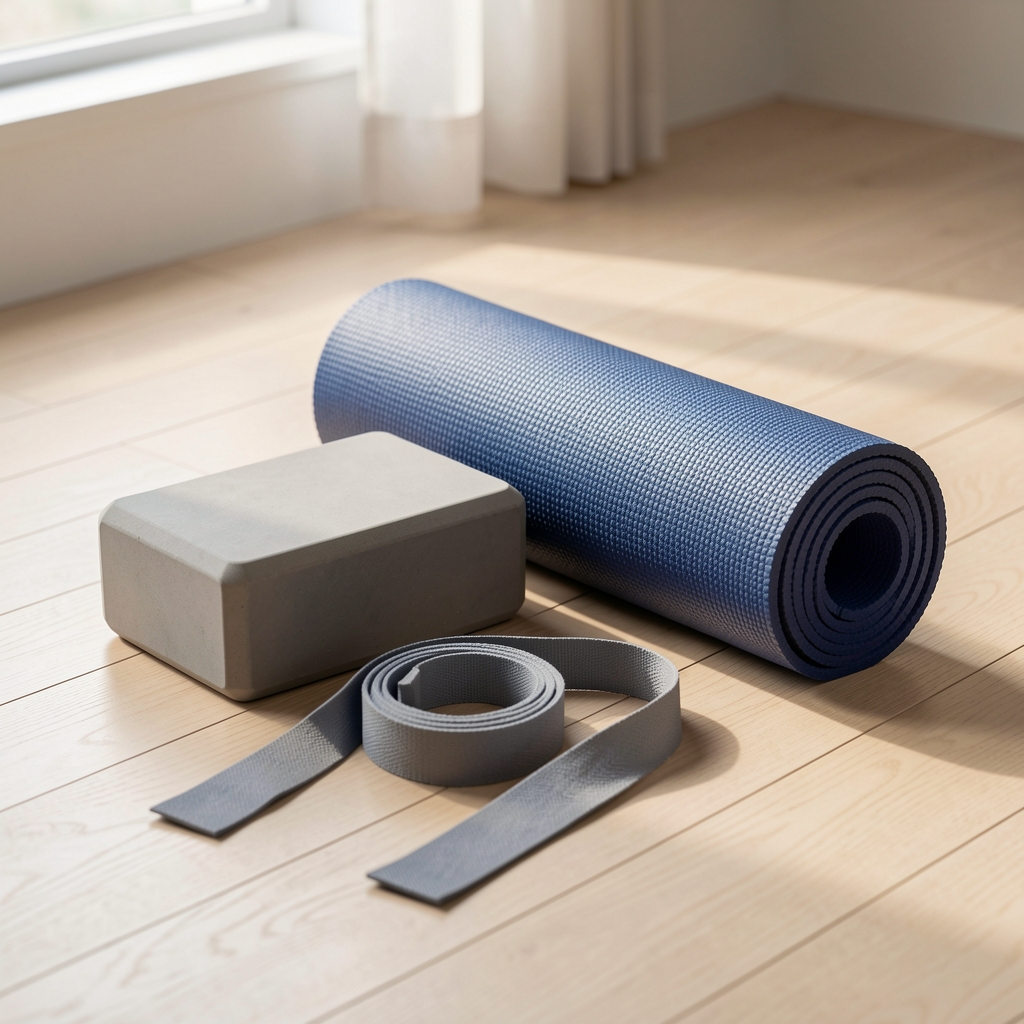
Much of what makes a sequence reliable is the opening posture. The choice of how to begin a practice has, in biomechanical terms, a logic to it: the body needs to transition from its overnight state — horizontal, cooled, joints under minimal load — into the range of motion required for standing and balance work. The conventional progression from supine to seated to standing reflects this logic directly.
Beyond mechanics, the opening posture has a psychological function. It is the posture the practitioner mentally identifies as the beginning. When that posture is consistent — when the sequence always begins in the same configuration — the act of taking that posture begins to function as a cue, signalling to the attention that a particular kind of engagement is required. The cue does not arrive fully formed on the first morning, or the fifth. It develops slowly, over weeks, and its gradual solidification is the thing worth watching for.
Savasana, the supine rest, is a reasonable opening for a gentle morning sequence precisely because it asks nothing of the body while orienting the attention. A slow breath count — five counts in, five counts out, for six or eight cycles — taken in savasana before the first movement creates a baseline quality of presence that the rest of the sequence builds on. Whether or not this is the opening used is less important than whether the opening is consistent.
Variation Within a Fixed Structure
A fixed sequence invites, over time, a particular quality of observation. When the same postures are practised in the same order, the practitioner begins to notice variation not in the sequence itself but in the body's response to it. The hip opener that was accessible last Tuesday feels closed this morning. The shoulder release that took effort last week has given way without resistance. These observations accumulate into a long-form picture of the body across seasons, workloads, and states of rest.
This is one of the less-discussed arguments for maintaining a fixed rather than a variable sequence: it turns the body itself into a source of information. A practitioner who moves through a different sequence each morning loses the comparative frame that fixed repetition provides. The data, such as it is, never accumulates in the same place.
That said, fixed does not mean static. A sequence can hold its fundamental structure while allowing the practitioner to linger where lingering is useful — an additional held breath in a forward fold, an extended spinal twist on the side that needs it. The distinction is between deliberate variation within a held structure and daily improvisation that prevents any structure from forming at all.
What Changes Over Time
The changes produced by a consistent morning flow are not always the ones expected. Physical flexibility increases, but often more slowly than anticipated and not uniformly across the body. What tends to change more quickly, and more noticeably, is the quality of the first hour of the day. Practitioners with an established morning sequence frequently report that the session functions as a kind of cognitive reset — that the transition from morning stillness through a physical sequence and back to stillness produces a state of attention that persists into the first working hours.
Whether this is an effect of the physical movement, the breath regulation, the structured attention, or some combination of these, is a question that published research in movement science has not yet fully addressed. What can be said with some confidence is that the practitioners who maintain the sequence long enough report a period — typically between three and six months in — where the absence of the practice becomes as noticeable as its presence.
This is the threshold worth working toward: not a flexibility milestone, not a posture achieved, but the point at which the practice is felt in its absence. At that point, the architecture of the routine has done what architecture is supposed to do — it has become invisible, structural, and functional whether or not it is noticed.
- ■ A consistent opening posture functions as a cue that develops over weeks of repetition.
- ■ Shorter sequences practised daily accumulate more change than longer sequences practised intermittently.
- ■ A fixed sequence turns the body into a comparative instrument — the variations observed are in the body, not the sequence.
- ■ The threshold worth working toward is the point at which the practice is felt in its absence.

Eleanor Whitfield
Eleanor has maintained a daily yoga practice for eleven years and writes with particular attention to the structural aspects of flexibility and the relationship between consistent movement and the quality of sustained attention. She holds a background in anatomy and movement studies and serves as lead editor of Dreni Gazette.
More from this author